
AMERICAVILLE
Keota Road Trip, Part II

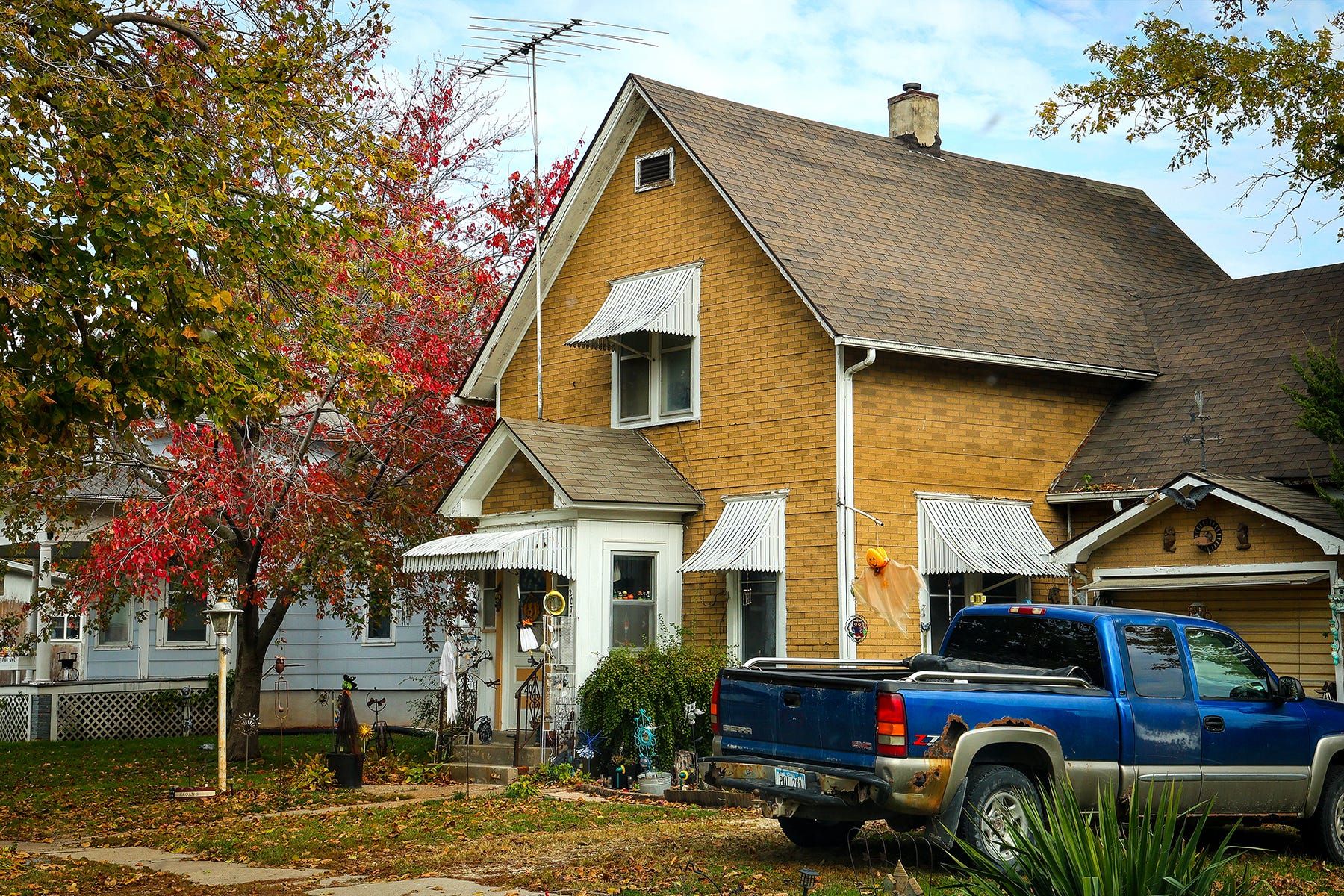
On November 18, 2025 I wrote about visiting my late wife’s gravesite in Keota and deciding to stay an extra day so I could photograph the wonders I had seen. It took a long time to get around to this Part II installment but here we are. Obsessing over the Great-American-Spiraling-Down-the-Drain on social media is no excuse, but recalling the memories now is like separating burnt pancakes from a dry cast iron skillet. It feels as if the small towns I visited are closer to the end than they imagine. Even in these pleasant places I detected a lingering fatigue. Who knows where all of this is headed? Not back to anywhere we’ve been, for damn sure. In any event, to ground us in the human condition I hereby dedicate this essay to Tom Mills of Keota, Iowa. Onward and be brave. - JHFarr
MY LATE WIFE’S UNCLE TOM was for many years top honcho at the local bank. He’s gone now as is perpetually brunette Aunt Shirley who ran a beauty parlor in her basement. We’d see them in Keota whenever we traveled to Des Moines to visit my in-laws. There was lunch involving leftover casserole or applesauce and afterwards we’d pair off in the living room—Kathy with Shirley and me with Tom—to drink coffee and speak of many things. I don’t know what Kathy said to Shirley because she rarely got a word in, but Tom and I could always find a common ground of cars, trucks, and adventures. One time he shared the story of his singular accomplishment as a bombardier on a B-17 while returning to his base in England from a mission over Nazi Europe during WW II. A bomb had gotten stuck inside and had to be dislodged over the English Channel so they could safely land.1 Nothing they’d tried had worked, so Tom climbed into the open bomb bay with the waves glistening below, straddled the bomb, and somehow got it loose! I imagined him banging on a bracket with a wrench amid the roaring engines and blasting wind, then grabbing onto something to keep from falling as the aircraft jerked up with the sudden lightness and everybody cheered. I’d trust anyone like that with my money at the local bank and back home people did.
Keota is true Midwestern. It seems utterly safe but probably isn’t and like most such places ain’t the town it used to be. An official history on the municipal website reveals that in 1887, Keota had eight trains a day: four freight, two passenger and two mail trains.2 How sane and civilized that sounds. The town was incorporated in 1873. According to one Isaac Farley in the Keota Centennial Book,3
“Keota is located on the eastern border of Lafayette Township, on the divide between Skunk River on the south and English River on the north, surrounded by as fertile prairie as the sun ever shone upon, which being occupied by an intelligent class of farmers, affords to Keota a business support excelled by none, and equaled by few inland towns in this or any other state in the Union. The Oskaloosa branch of the C.R.I. & P.R.R.4 passes through the town on a line due east and west, thus avoiding the obtuse and acute angles so often seen in the business part of our R.R. towns”
Intelligent farmers and straight railroad tracks! But what about the name?
“Tradition says that the Reverand D.V. Smock suggested the name ‘Keoton’ for this new town, being the first and last letters of Keokuk and Washington Counties. The story goes that either the Rock Island R.R. or the Post Office Department changed the name to ‘Keota’ without explanation other than for the purpose of easier pronunciation.”
That’s so Iowan I can hardly stand it. On the other hand, Henry Gannet, author of the Washington, D.C. Government Printing Office publication The Origin of Certain Place Names in the United States [1905] writes that “Keota is derived from an Indian name meaning ‘gone to visit’ or ‘the fire is gone out’.”
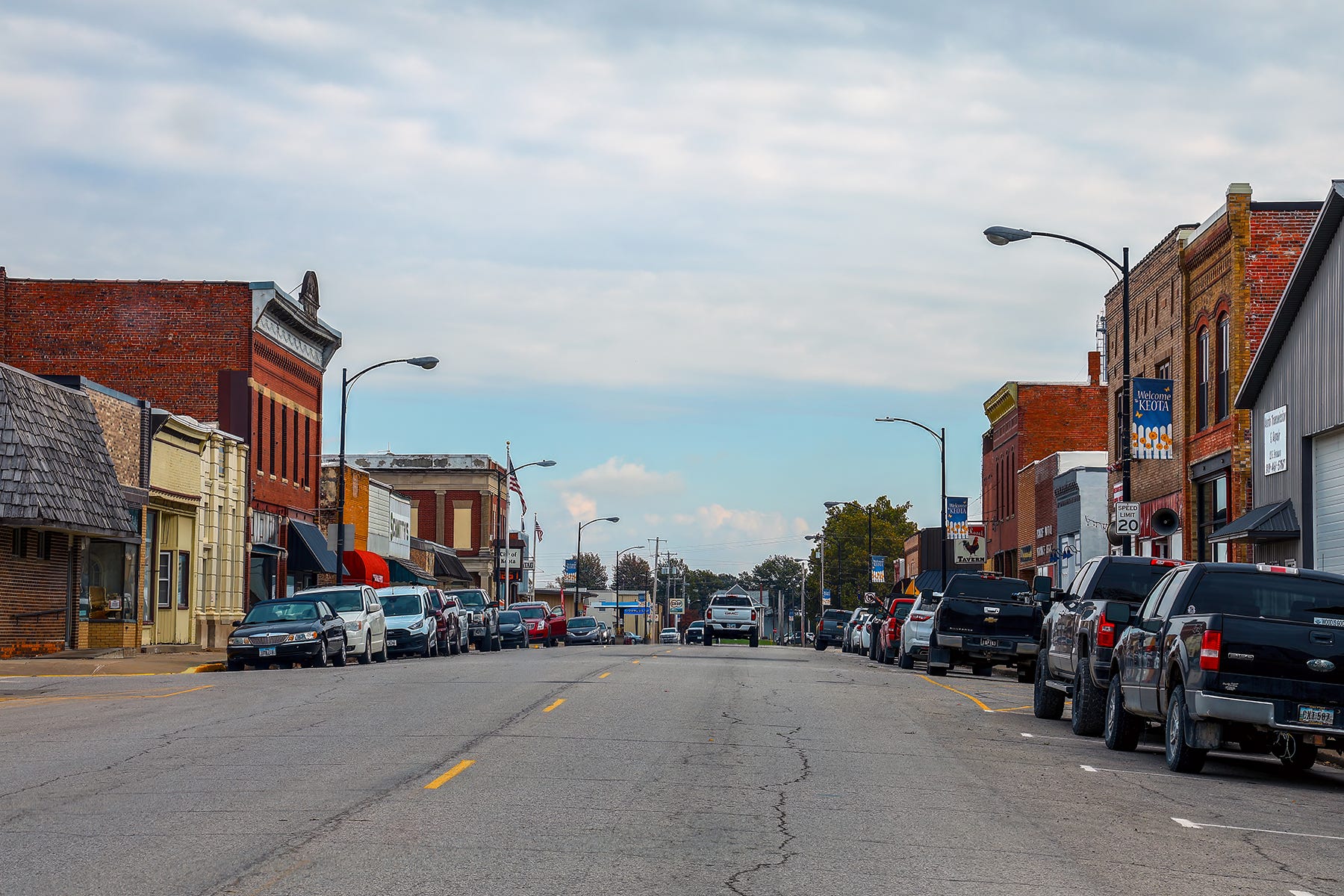
Welcome to downtown Keota. There were plenty of shiny pickup trucks and the usual species of Iowa minivans. It was very quiet. I had no trouble standing in the middle of the street and taking pictures at 12:00 noon on a Friday. Some of the masonry buildings are boarded up amid the flags. Just out of sight here beyond the tavern I found a deceased monarch butterfly lying by the curb, which greatly puzzled me. Years before in Taos, Eya Fechin5 told me, “Kathy is a butterfly…” You don’t forget a thing like that. They do breed this far north in summer before migrating to Mexico in the fall, but what was such a fragile thing doing on the pavement now? Had it fallen from a grille or radiator meant for me to find? All the memories came flooding back as I stood there, stunned, and placed it in an envelope to take back to my room. I didn’t keep it, though. The discovery was the intervention, after all.
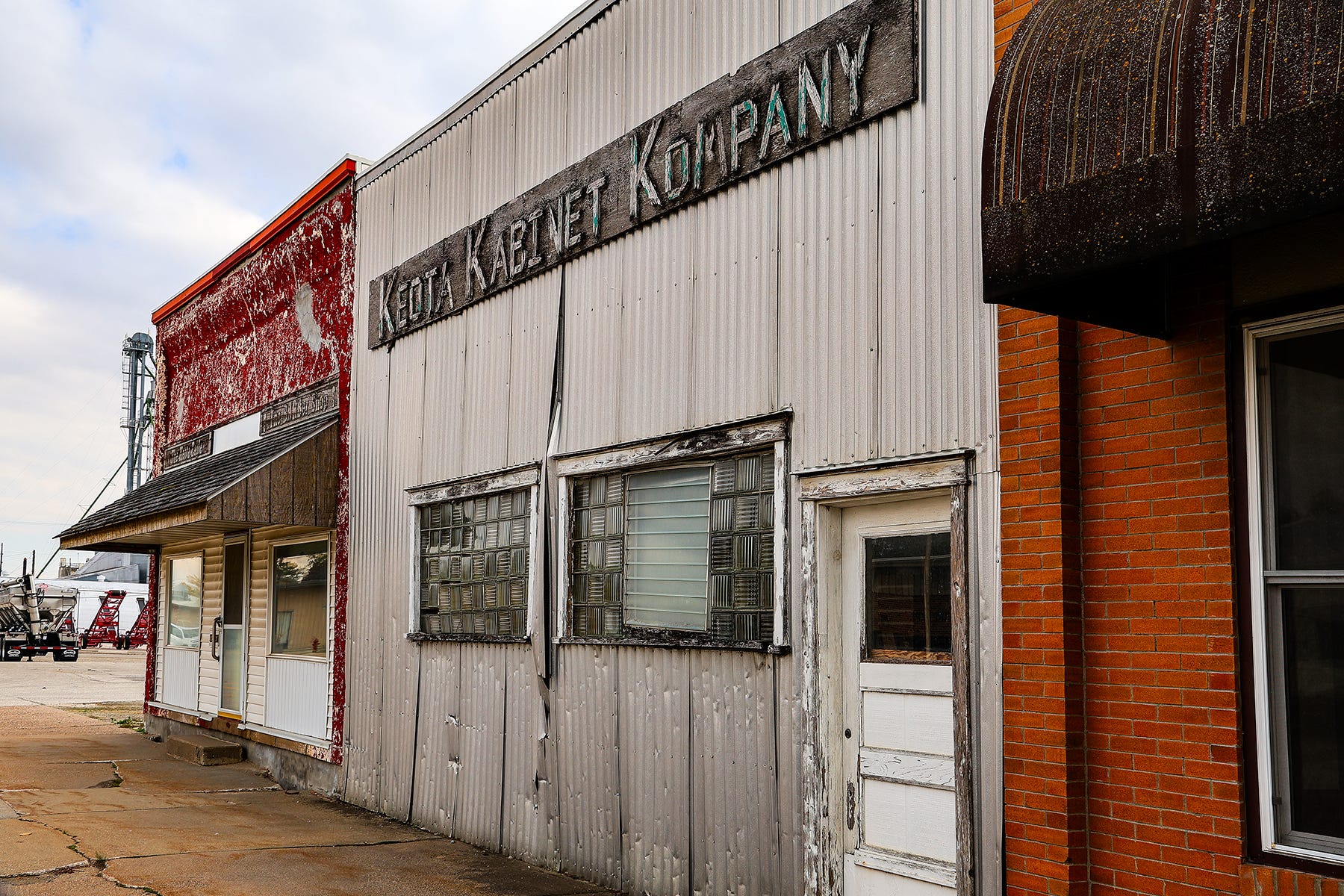
I think it’s safe to say these businesses are no more. The cabinet company exhibits a remarkable window treatment, though. Glass “bricks” and a jalousie thing for ventilation. I couldn’t tell if the metal panels were bent and battered from someone trying to break in or out. The storefront on the left was home to both a local weekly paper, the Keota Eagle (founded in 1877), and a barber shop. It would have been nice if they had left the sign, which I suppose is now in someone’s den. I spent some time looking in the windows. The interiors were full of wondrous junk I decided not to photograph, some things being better left to mystery. I was also drawing mild attention and elected to behave.
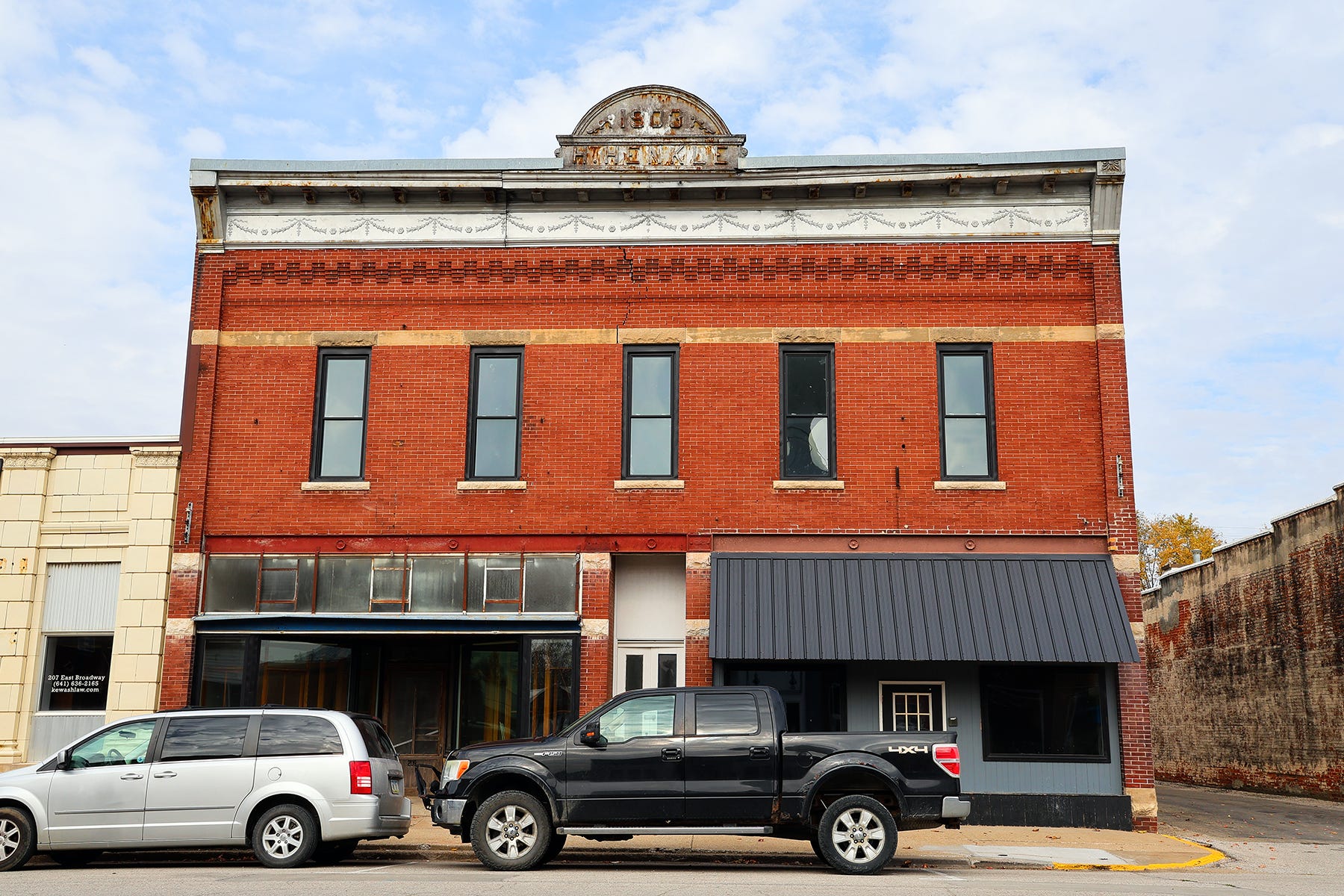
I don’t know what Mr. Henkle sold, but that looks like a showroom window on the left so maybe furniture or clothing? Whenever I see an “urban” space like this I want to rent the loft for art or band practice except that I don’t have a band and this one’s in Keota (population 886). It’s sad though, really. There’s an even larger building a block away converted to apartments6—I could tell by the plastic trikes outside and kids’ clothes on a rope—but with the larger upstairs windows boarded up.
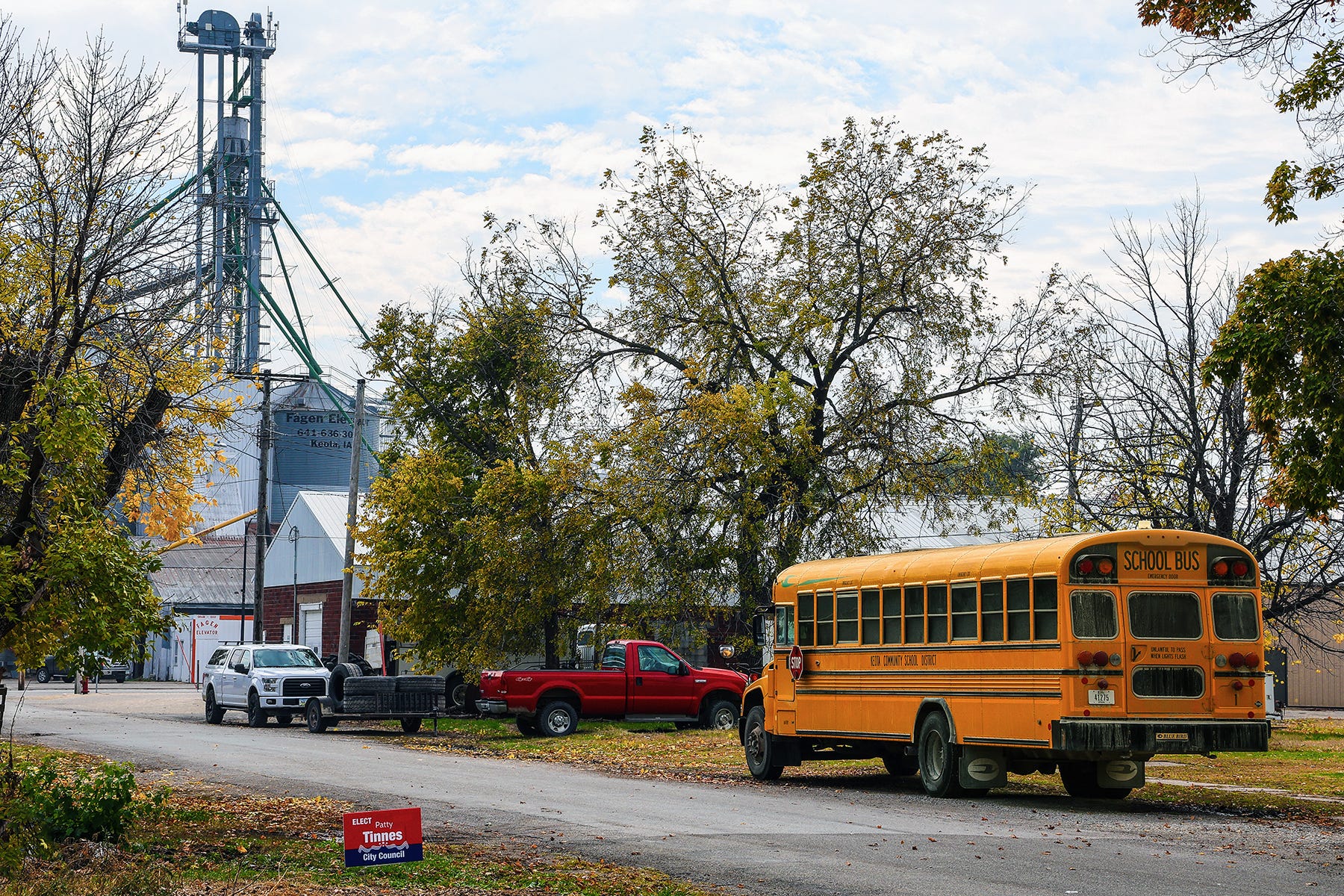
A block away things look a little better. Trees help. It’s also nice to see a latish model pickup truck with just two doors like God intended. I wonder what the communications gear is on that tower? A cold nostalgia creeps in, too. Early morning, peanut butter and jelly sandwich in a metal lunchbox, scuffing along a quiet street to meet the bus and feeling sorry when it comes. Always the newest kid in class.
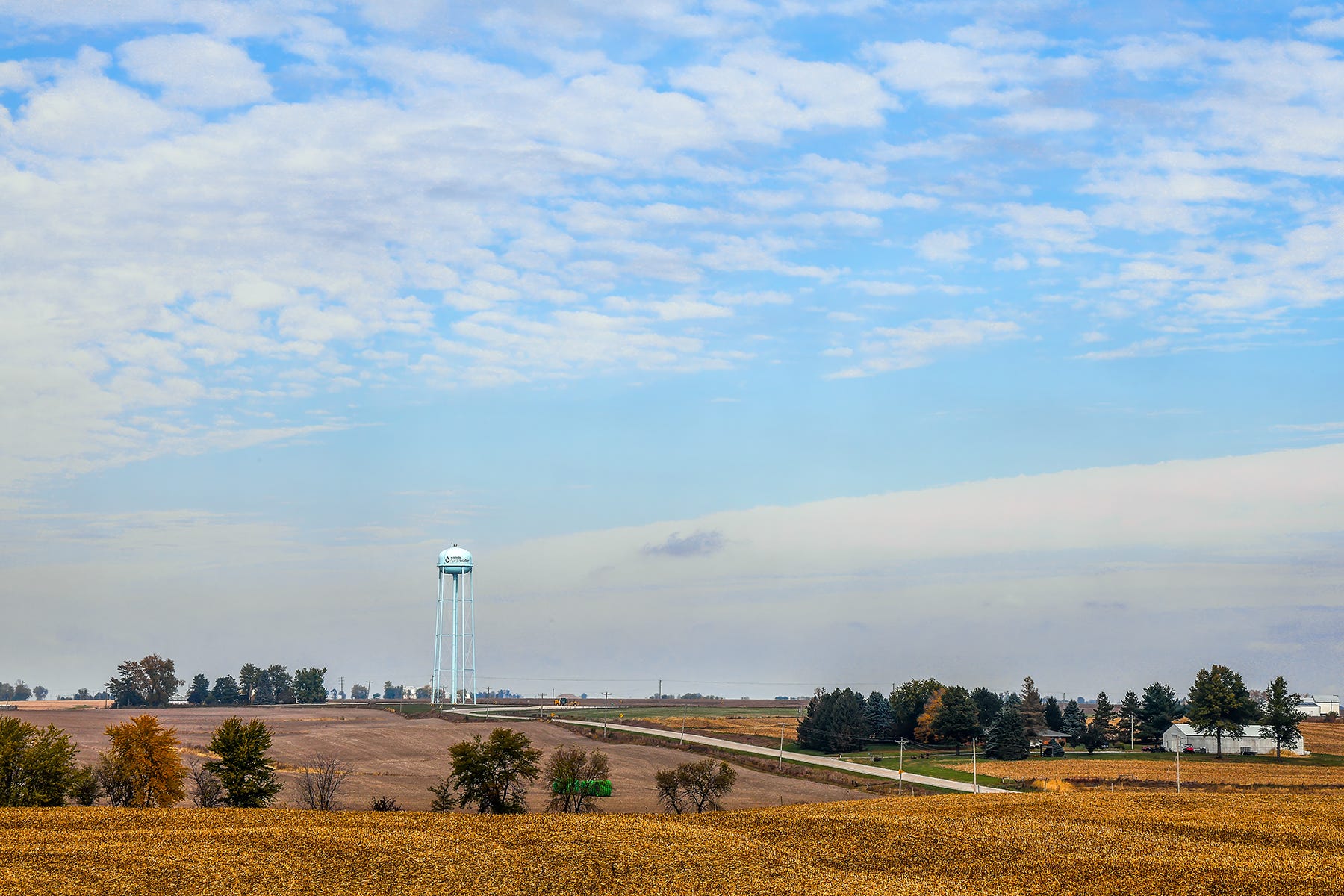
This is just past the farm shown in the final photo of Part l. Pretty, but after a while the wholly transformed landscape makes me uneasy. Every square inch of arable land is plowed, planted, and fertilized. Nitrates and other chemicals in the water table are problematic. That tower doesn’t say “KEOTA” either, because it belongs to the regional rural water association. Big trees, real grass yards, and old wooden houses make a difference, though. They almost grab me now but what I’ve learned from wilderness would strangle me. I’m also no boy anymore except in spirit, fine because the Johnny in me loves the mountains and the danger. All in all, a little shaky to my wild high desert sensibilities honed by 25 years in el Norte—okay for some of course, and God bless every one of you.
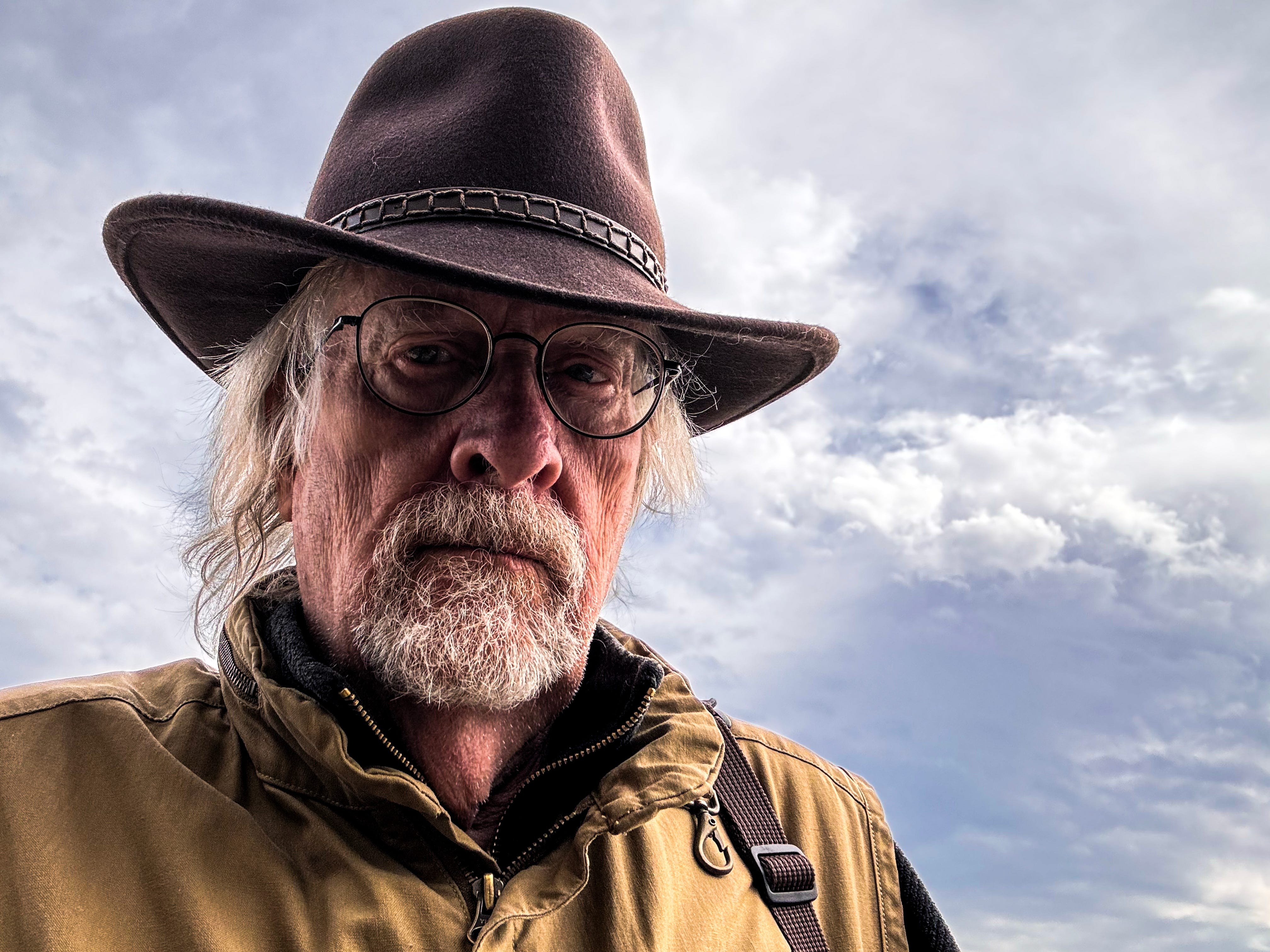
Here’s me moody and wary getting ready to load my truck and leave:
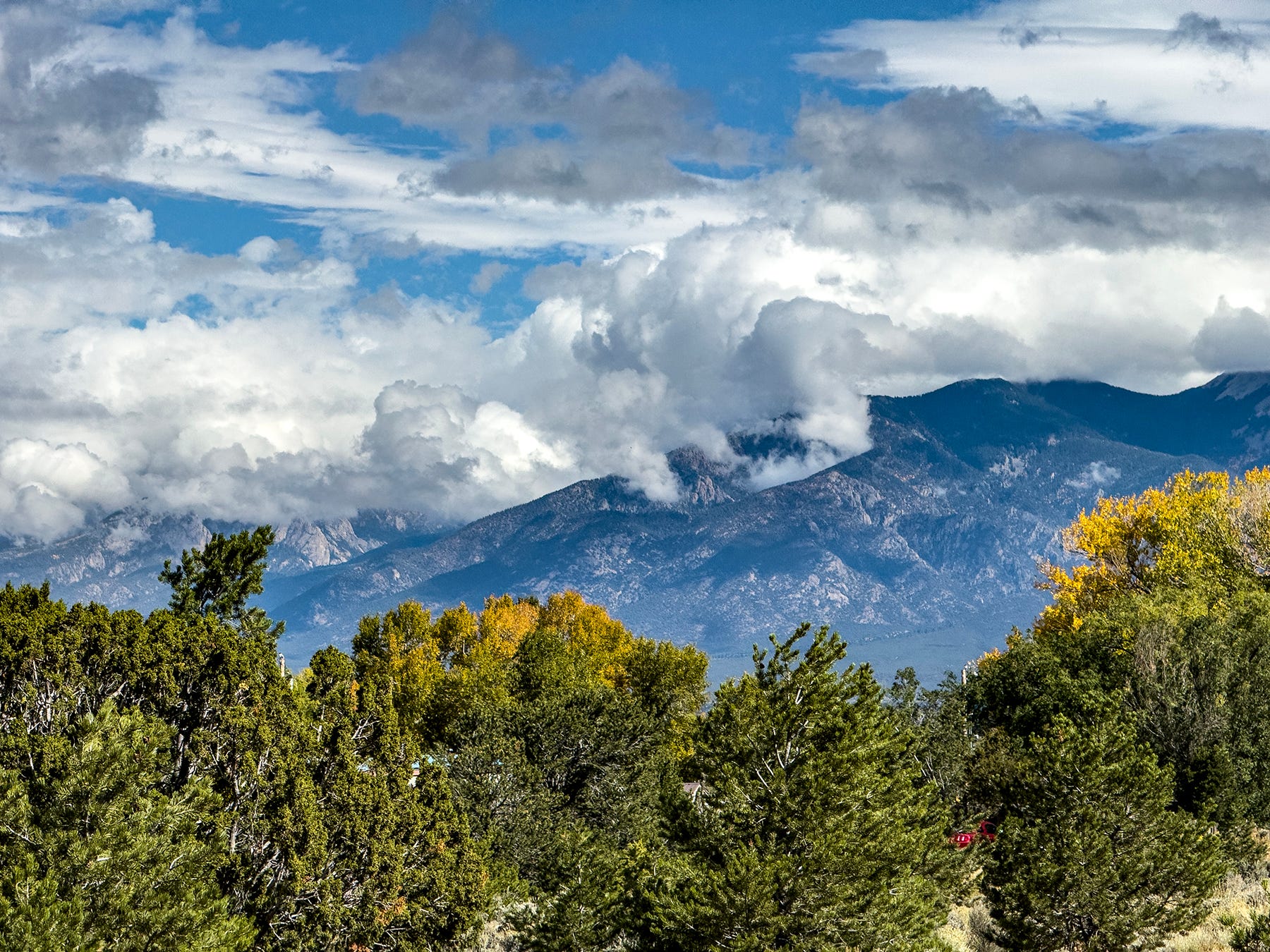
Heading back to here, of course. Vantage point is 100 yards from my front door. Doesn’t it go wham?

I promised you the Villisca Axe Murder House and more. Expect delivery shortly this time, and then the trip back home.

The thing was likely armed at that point and any shock could have detonated it.
I saw none.
Publication date not noted but surely 1973, except the prose sounds wildly dated.
Chicago, Rock Island, and Pacific Railroad. Went defunct in 1980.
Eya Nicolaevna Fechin (June 14, 1914, Kazan, Russian Empire – September 20, 2002, Taos, USA)[1] was the daughter of and thereby the long-serving model for a Russian, Soviet and American artist Nicolai Fechin; and a psychic, dancer and psychiatrist (art therapist), author of memoirs about Nicolai Fechin, books and articles about his work, and founder of a private museum in Taos dedicated to his work.[2]
You can see it in the MAIN STREET photo.
8 trains a day!! Wow that’s great. We’ve really bungled things.